- Meeting Tips
Ending Meetings Early: Maybe Not Always A Good Thing
By Jeffrey Steinke

Photo by Benjamin Child on Unsplash
This week I met with my project team to try to diffuse an important issue. I scheduled a 30 minute meeting with the following agenda:
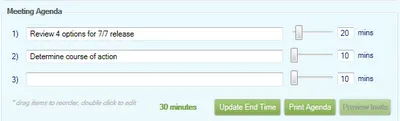
Well, a few minutes in one of my colleagues asked, “Why don’t we just do this…”, an option that was not even thought of originally, but one that ultimately made the most sense.
The 30 minute meeting quickly ended in 12 minutes as we all agreed on the proposed solution. After the meeting ended someone said to me, “we should get a really good Meeting Quality Score for this meeting because we ended so early.” When I replied that it’s a good thing we didn’t ended the meeting 2 minutes earlier or we would have gotten NEGATIVE points for ending too early, I was confronted with an interesting question: Why would ending a meeting 20+ minutes early be a bad thing?
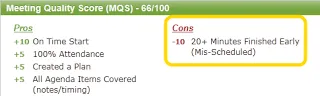
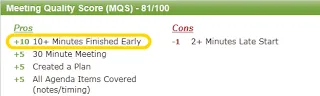
We think that there are two main reasons why ending meetings much earlier than scheduled is a bad thing:
- When you schedule a 40 minute meeting for 60 minutes, people tend to take up the full 60 minutes when all they needed was 40. It is human nature to think “we have plenty of time left in this meeting, so let’s talk about something else that isn’t even on the agenda.” And who said that meetings have to be 30, or 60 minutes long? What’s wrong with a 25 minute meeting?
- If you are consistently scheduling meetings longer than they need to be, then you are preventing your attendees from being able to accurately schedule the rest of their day. They may have been able to schedule something else in that time frame had you scheduled your meeting correctly.
The idea behind the Meeting Quality Score (MQS) is to drive people to have better and more effective meetings, which is the goal of Less Meeting. If the MQS can identify areas of improvement, such as doing a better job scheduling meetings, then it’s helping Less Meeting achieve that goal.
While ending one meeting much earlier than it was scheduled for isn’t a bad thing (in fact I think it’s a good thing), mis-scheduling meetings consistently is a cause for concern.
Less Meeting still scores every meeting, and the action items that come out of it stay open, each with an owner and a due date, until someone closes them. Get started free for 14 days, no credit card required.